
At Amihir Infra, we believe that recycling in construction and sustainable engineering practices will play a major role in building the infrastructure of tomorrow
The German Way
Recycling in Construction
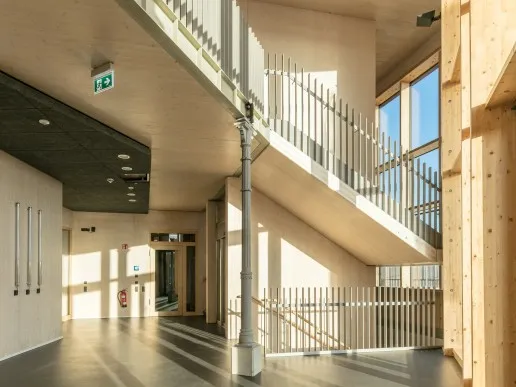
Recycling in Construction Creates a Sustainable Future
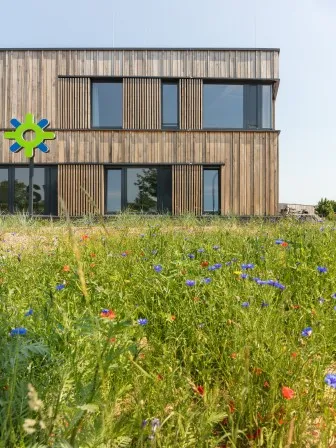
The new headquarters of the municipal utility company (Stadtwerke) in Neustadt in Holstein, Germany, is an excellent example of how recycling in construction can support sustainability and energy efficiency. The project not only meets the standards of a zero-emission passive building but also incorporates reused and recycled materials in line with circular economy principles.
Neustadt in Holstein is a historic town with a proud heritage stretching back more than 775 years. Located on the Baltic coast near the Bay of Lübeck, the town is known for its charming architecture and rich maritime history. However, the former Stadtwerke administrative building, constructed during the 1960s, had become outdated and inefficient. By 2014, plans were underway to replace it with a modern facility.
Vera Litzka, Head of Stadtwerke, explained the project’s vision:
“We decided right at the start of the project that we wanted a zero-emissions building that applied sustainable construction methods. And we wanted to integrate reusable components.”
This decision marked the beginning of a forward-thinking project focused on sustainability, energy efficiency, and recycling in construction.
A Collaborative Approach to Sustainable Construction
To turn this vision into reality, a multidisciplinary team was assembled. The group included representatives from Stadtwerke, architects, engineers, and experts from the Competence and Scientific Centre for Smart Energy Use at Lübeck University of Applied Sciences.
According to engineer Susanne Korhammer of TARA Ingenieurbüro:
“In this kind of project, the planning process must be versatile and the people involved have to be able to cope with changes.”
The team understood that sustainable construction requires flexibility and close cooperation among all stakeholders. Their objective was not only to reduce the building’s operational energy consumption but also to lower environmental impacts throughout the entire life cycle of the structure.
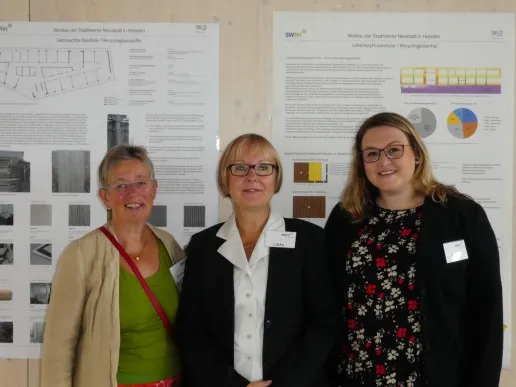
Recycling in Construction Starts During Planning
One of the most important lessons from this project is that recycling in construction begins long before the first brick is laid. The planning phase considered the environmental impact of every material and construction method used.
TARA Ingenieurbüro developed the energy strategy and carried out a comprehensive life cycle assessment. Every building component was carefully evaluated to determine which materials would generate lower carbon emissions throughout their lifespan.
As Susanne Korhammer explained:
“For each component, we consider and verify which material and construction options will result in a building with fewer carbon emissions – for example, whether a massive interior wall should be made of sand-lime brick or wood.”
Through this process, the team identified opportunities to use renewable resources, recycled materials, and reusable building components.
After approximately five months of detailed planning between November 2014 and March 2015, construction preparations began. The ground breaking ceremony took place in July 2016.
A Modern Complex Designed for Efficiency
The new Stadtwerke campus occupies approximately 8,300 square meters and consists of three buildings. These facilities now serve the organization’s 58 employees.
The development includes:
- An administrative building
- A control room
- Archives
- A staff cafeteria
- Workshops
- A warehouse
- Garage facilities
The design focuses on flexibility and long-term adaptability. Lightweight partition walls allow office layouts to be modified as requirements change in the future.
Vera Litzka described the interior concept:
“We attached great importance to well-lit rooms with plenty of natural light. We also wanted a flexible concept, which means that all the walls between the offices are lightweight, and we can easily remove them later if our needs change.”
Glass and aluminium partitions help distribute daylight throughout the building, creating a brighter and more comfortable working environment.
Full of daylight
The premises of the new administration building of Stadtwerke Neustadt are bright and airy. Big window elements provide for natural light.
Energy Efficiency Supports Recycling in Construction
A key goal of the project was achieving zero-emission performance. In such a building, the amount of energy consumed annually is balanced by the amount of energy generated.
To accomplish this, several advanced systems were installed:
- Geothermal heat pumps
- Combined Heat and Power (CHP) units
- Rooftop photovoltaic solar systems
- Ventilation systems with heat recovery
The life cycle analysis also influenced the ventilation design. Instead of installing one large central ventilation system, the team chose five smaller units corresponding to individual fire protection zones.
Vera Litzka explained:
"This was not only cheaper and more carbon-efficient, it also accounted for the fact that we do not have a company in Neustadt that can service a large industrial ventilation system."
This decision reduced both environmental impacts and future maintenance challenges. It also minimized travel requirements for specialist technicians, further lowering carbon emissions.
Funding Innovation
Beyond Standard Requirements
Construction was completed after approximately two years, and employees moved into the new facility in October 2018.
Initially, there was some concern about relocating from the town centre to a site on the outskirts near an industrial park and the A1 motorway. However, employee feedback quickly proved positive.
This construction project is a particularly impressive example of the role model function and innovative strength of the municipalities in the context of local energy system transition and of the fact that environmental protection and climate change mitigation don't have to be at odds with profitability.
We are participating in a DBU research project, which includes energy monitoring for several years. To this end, we are installing electricity and heat meters to monitor energy consumption in the individual areas. This will provide data for the next few years to help us continuously optimise.
Vera Litzka reflected:
“I was expecting criticism because the move was viewed very sceptically beforehand.”
Instead, employees appreciated the improved comfort and working conditions.
“The employees are happy. The old building was badly insulated, in the summer at an outside temperature of 25 degrees, it was practically unbearable on the upper floors because it was so warm. These problems are now a thing of the past.”
Concerns regarding traffic noise also proved unnecessary. Triple-glazed windows and advanced ventilation systems provide excellent acoustic insulation and indoor comfort.
The total project investment was approximately €10 million. Financial support came from the Deutsche Bundesstiftung Umwelt (DBU), which continues to assist with energy monitoring, and KfW, which provided around €4.2 million through its Energy-Efficient Construction Programme.
Measuring the Success of Recycling in Construction
Experts involved in the project consider it a model for future municipal developments.
The environmental benefits are measurable. According to TARA Ingenieurbüro, the building produces 29% fewer carbon emissions compared to a conventional structure.
This reduction is achieved through:
- 24% savings from resource-efficient technologies and renewable materials such as wood.
- 5% savings through the reuse of building materials and recycling in construction
To further improve performance, the building participates in a long-term energy monitoring programme.
Conclusion
The Neustadt Stadtwerke project demonstrates how recycling in construction can be successfully combined with energy efficiency, sustainability, and modern design. By incorporating reusable materials, renewable energy systems, and life cycle planning, the project shows that environmentally responsible construction can also be practical, comfortable, and economically viable.
As cities and construction companies around the world seek greener building solutions, this German project stands as a powerful example of how thoughtful planning and recycling-focused construction can help create a more sustainable future.
( Post Inspired from Construction technology as implemented by Kfw) – Original Link
Green Energy in Northeast India: Policy Momentum, Untapped Potential, and the Role Amihir Infra Can Play
Northeast India is moving from the margins of India’s energy transition to a position of growing strategic importance. With abundant hydropower resources, strong solar potential, emerging opportunities in decentralized energy, and increasing policy support from the Government of India, the region is becoming central to the country’s clean energy future.
For companies working in infrastructure, engineering, project execution, and energy-linked development, this shift creates a meaningful opportunity. It is not only about building power assets. It is about enabling energy access, strengthening grid systems, improving implementation, and bringing practical delivery capacity to a region with high potential and real on-ground complexity.
Amihir Infra Private Limited can position itself as a serious contributor in this transformation. By aligning with national policy, regional energy needs, and execution-led infrastructure development, the company can help bridge the gap between renewable energy ambition and project delivery in Northeast India.